- May 22, 2025
Which Side Of Your Brain Is Dominant?
"Which hand do you read?" It's a question I get asked often when people find out what I do.
If you've had a hand reading with me, you already know I read both. The right hand corresponds to the left brain, and the left hand corresponds to the right brain.
Because we live in a world that primarily values the attributes of the left brain, Hand Analysis looks at what's in the right hand as representing the public persona. What's in the left hand represents the inner life and what is shared only with those closest to us.
This is true whether a person is right-handed or left-handed.
Here's a myth busting fact: studies have shown that only about 30% of lefties are right brain dominant, while as many as 3% of righties are right brain dominant.

Indicators of Dominance In Your Hands
The science is not solid on this, but there are theories that suggest the thumb that is on top when you clasp your hands together indicates which side of the brain is dominant. If your right thumb is on top, you'd be considered to be more logical and analytical. If it's your left, the theory is that you rely more on instinct and intuition.
More so than the thumb, I look to the Head Line for information about left or right brain styles of thinking. The Head Line is the horizontal crease that begins on the thumb side of the hand and traverses the center of the palm.
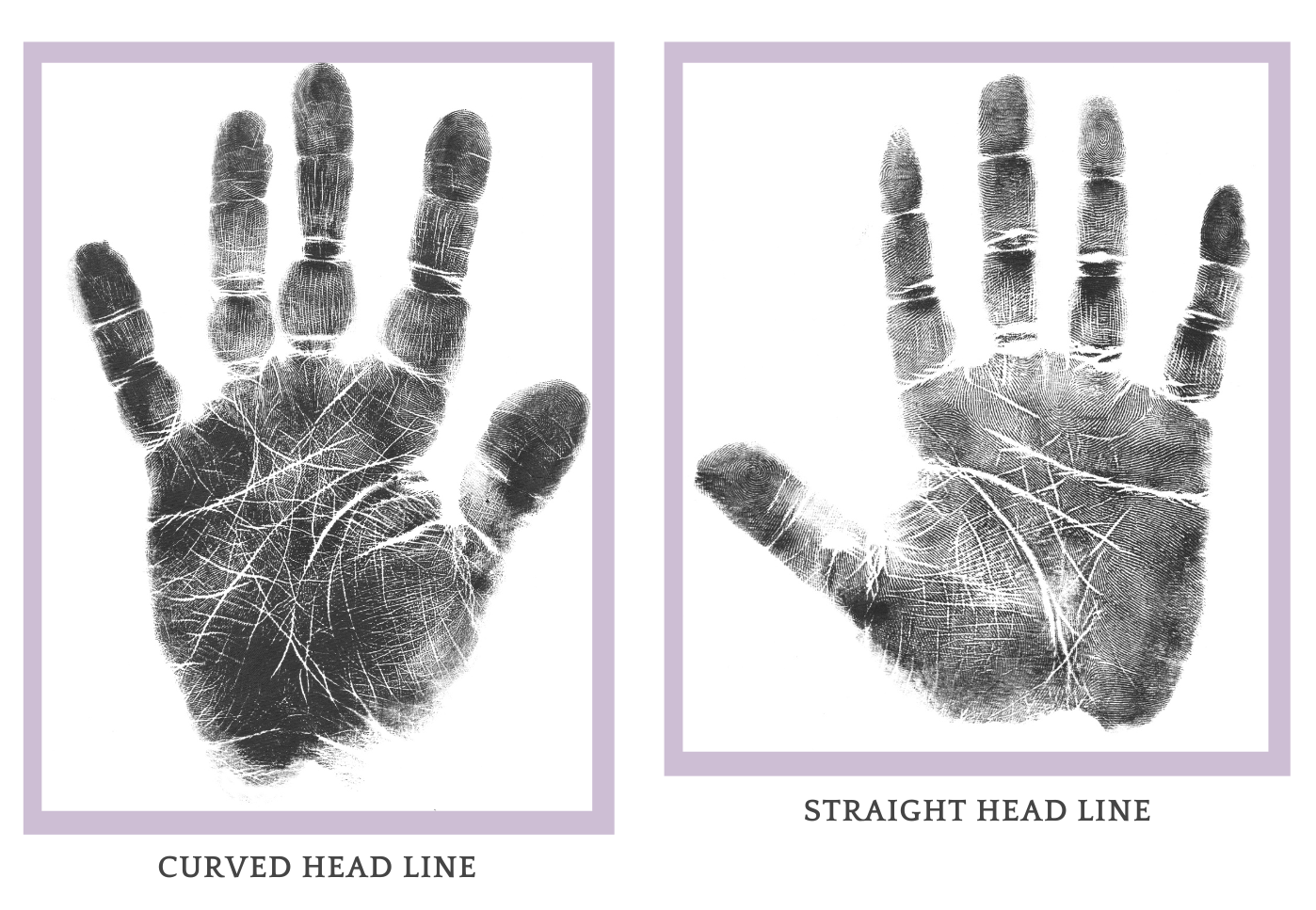
Curvy Head Lines tend to be more right-brained, straight Head Lines more left-brained. In the handprint on the left, the Head Line is curvy and flows downward like a waterfall. This is an extremely right-brained person. The hand on the right has a fairly typical example of a straight Head Line.
What if you have one of each? It happens! You may use more of your left brain at work, and intuition in your personal life. Or vice versa.
What Really Happens On Each Side Of The Brain
When neuroscientist Jill Bolte Taylor had a stroke that incapacitated all of her left brain functions, she was able to observe firsthand the way each half of the brain functioned.
She describes the right hemisphere as concerned with the present moment. She said it receives information as a simultaneous energy stream, thinks in pictures not words, learns kinesthetically through bodily movements, and does not differentiate one energy being from another. It experiences us all as connected.
She characterizes the left hemisphere as concerned with the past and the future, picking out details from our experiences to organize and categorize. It thinks in language in a linear and methodical fashion. And it defines each of us as separate from the other.
(Watch her TED talk here. Or better yet, read her inspiring memoir.)
Back To What I Was Saying About Living In That Left-Brained World
Dr. Taylor described the time after her stroke, when her left brain functions were non-existent, as euphoric. Without the chatter of her left-brain, she felt peace. She even went so far as to say that she was torn about whether she wanted to regain her left-brain functions as she recovered.
Dr. Taylor knew she needed language to communicate, analysis to make decisions, and a strong sense of self to succeed. We all do. But she also recognized that the logical left brain is where the inner critic lives. It's where we pass judgement on ourselves and others. The right brain has no comparable faultfinder.
I believe that the more time we spend choosing to run the deep inner peace circuitry of our right hemispheres the more peace we will project into the world, and the more peaceful our planet will be.
—Jill Bolte Taylor
Our left-brained world has long dismissed and denigrated the right-brained functions of intuition, empathy, and connectedness to our fellow humans. And it appears to be getting worse as we become more and more immersed in our tech. It's difficult impossible to stay in the present moment when you're doomscrolling!
No matter whether your crossed thumbs or your Head Line indicate a left or right brain emphasis, you can choose to develop the right brained qualities of compassion, intuitive knowing, sensory receptivity, and oneness.
In fact, the future of humanity depends on it.